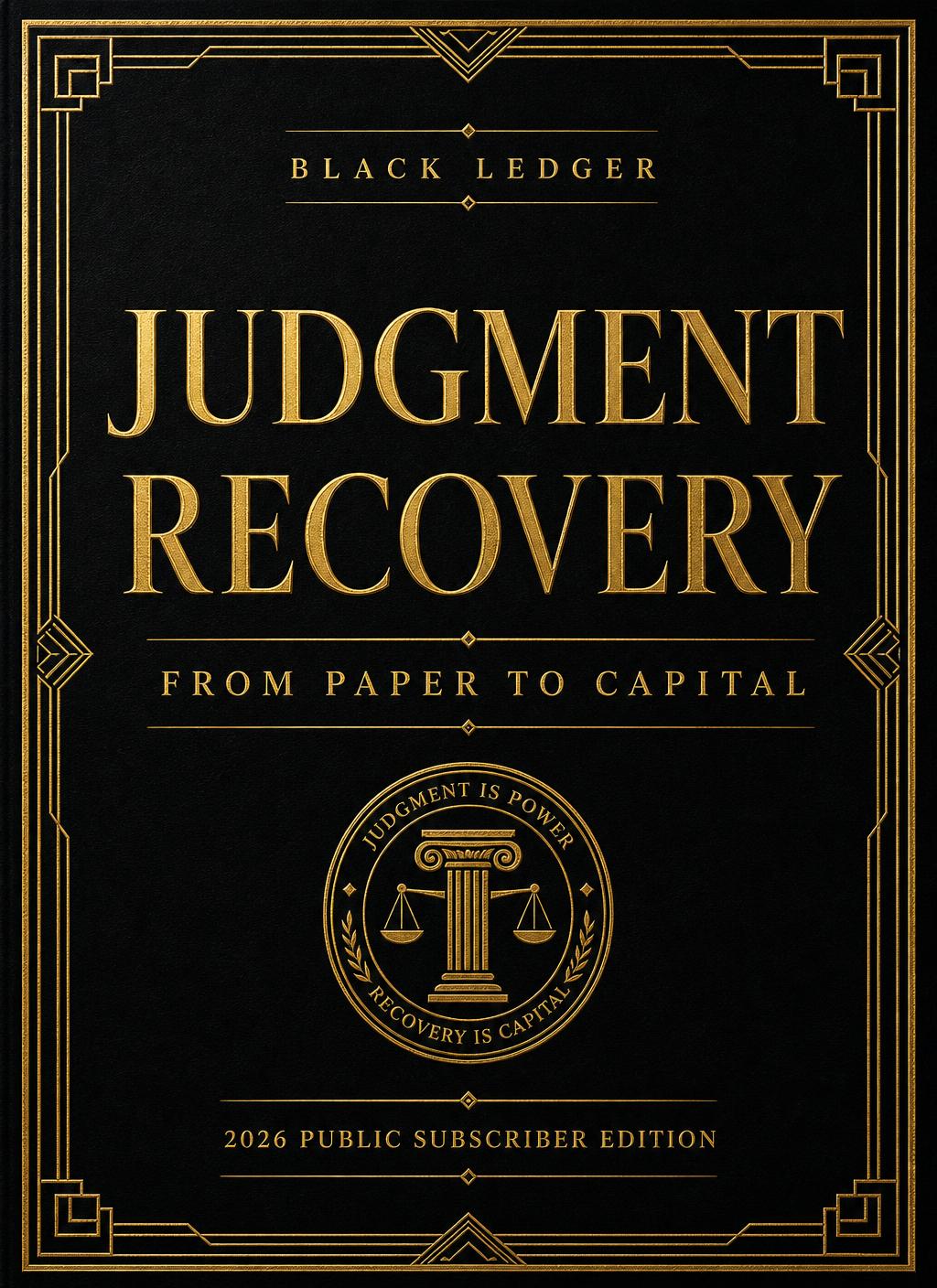
Executive Summary
A judgment is a legal asset, not cash. Its value depends on enforceability, time remaining, debtor intelligence, asset reach, priority, procedural accuracy, and the economics of execution. Recovery is the discipline of converting a static court record into a sequence of investigation, leverage, lawful process, negotiation, and closing controls.
Judgment Recovery follows the judgment lifecycle from intake through satisfaction: validate, locate, position, discover, execute, negotiate, preserve, and close. Each stage is paired with the question it answers and the failure risk it carries — acting on a stayed or expired judgment, spending before identifying reachable value, losing priority while assets transfer, using the wrong writ or jurisdiction, or discounting a settlement without security or default remedies.
Eight parts cover judgment asset architecture, intake and validation, domestication and jurisdiction, asset intelligence and discovery, execution and enforcement remedies, complex recovery and distress, operating systems and portfolio management, and 50-state research profiles with checklists and sources.
- —Validate finality, ownership, balance, interest, and stay status before spending a dollar
- —Domesticate judgments across state lines without procedural defects
- —Run post-judgment discovery that produces usable asset evidence, not paper
- —Match the remedy to the asset — lien, levy, garnishment, turnover, charging order, or receiver
- —Spot fraudulent transfers and alter-ego exposure before value disappears
- —Calendar renewal, lien continuation, and interest accrual across a whole portfolio
What You'll Learn
What's inside the manual.
Judgment Enforcement Strategy
Where value exists, which remedy reaches it, what it costs, what can interrupt it, and how fast it converts into net recovery.
Domestication & Jurisdiction
Registering and enforcing judgments in sister states, the timing traps, notice requirements, and where domestication is worth the cost.
Asset Investigations
Debtor, entity, income, receivable, real property, and decision-maker mapping — building an evidence file that supports a writ.
Judgment Liens
Creating, recording, and continuing judgment liens on real and personal property to preserve priority while enforcement proceeds.
Bank Levies
Locating deposit relationships, timing the levy, service mechanics, exemption claims, and reconciling the return.
Wage & Receivable Garnishments
Wage garnishment limits and process, plus garnishing commercial accounts receivable and third-party obligors.
Turnover Orders
Compelling delivery of identified assets, documents, and property interests when writs alone cannot reach them.
Charging Orders
Reaching LLC and partnership interests, distribution rights, and the limits of the exclusive-remedy rule.
Receiverships
When a receiver is proportionate, what the appointment achieves, and the cost and control tradeoffs.
Fraudulent Transfer Actions
Badges of fraud, voidable-transaction analysis, transferee liability, and preserving claims before limitations run.
Bankruptcy Considerations
Running a current bankruptcy check before each coercive act — the automatic stay, exemptions, dischargeability, and preference exposure.
Judgment Renewal & Preservation
Renewal windows, dormancy, interest accrual, lien continuation, and balance accuracy across long-horizon files.
Settlement Architecture
Converting leverage into dependable payment with security, verification, confessions, and default remedies.
Nationwide Enforcement Planning
50-state research profiles and operational checklists for multi-jurisdiction portfolios.
Why This Guide Matters
Most judgments are never collected — not because the debtor is empty, but because nobody ran validation, discovery, and execution as separate, calendared workstreams.
Enforcement is jurisdiction-specific and fact-sensitive. Exemptions, stays, judgment duration, lien creation, interest, service, and renewal rules all vary by state.
The wrong remedy applied to the right asset still fails. Matching writ to asset is the difference between a return and a wasted filing fee.
A judgment that lapses, goes dormant, or carries an unreconciled balance is not an asset — it is a liability on the balance sheet dressed as one.
Who Should Read It
- —Credit Managers and Credit Analysts
- —Commercial collection professionals
- —CFOs and Controllers
- —Commercial finance and treasury teams
- —Attorneys and litigation support teams
- —Asset recovery professionals and judgment enforcement teams
- —Secured creditors, judgment buyers, and funders
- —Business owners carrying unpaid judgments
Publication Information
- Title
- Judgment Recovery
- Publisher
- Black Ledger
- Edition
- 2026 Public Subscriber Edition
- Published
- August 2026
- Pages
- 225
This publication is an educational field manual and operational planning aid. It is not legal advice, does not create an attorney-client relationship, and is not a substitute for current statutes, court rules, judicial decisions, clerk instructions, local practice, or advice from licensed counsel in the governing jurisdiction. Verify current primary authority before every filing or enforcement act.
Related Resources
Field Manual — Public Subscriber Edition
2026 50-State Judgment & Lien Renewal Guide
Judgment and judgment-lien expiration, renewal mechanics, per-county lien continuation, planning costs, and statutory checkpoints for all 50 states plus federal.
A Field Manual for Secured Creditors
Lien Mechanics
A comprehensive field manual covering commercial lien creation, perfection, priority, enforcement, UCC Article 9, statutory liens, construction liens, judgment liens, bond claims, and practical recovery strategies for secured creditors.
Commercial Credit & Collections — Book 4
The Commercial Lien Playbook
Mastering recovery in high-stakes B2B collections — the strategy, psychology, and legal mechanics of filing and enforcing UCC, mechanic's, and judgment liens, with scripts, templates, and a full lien lifecycle checklist.