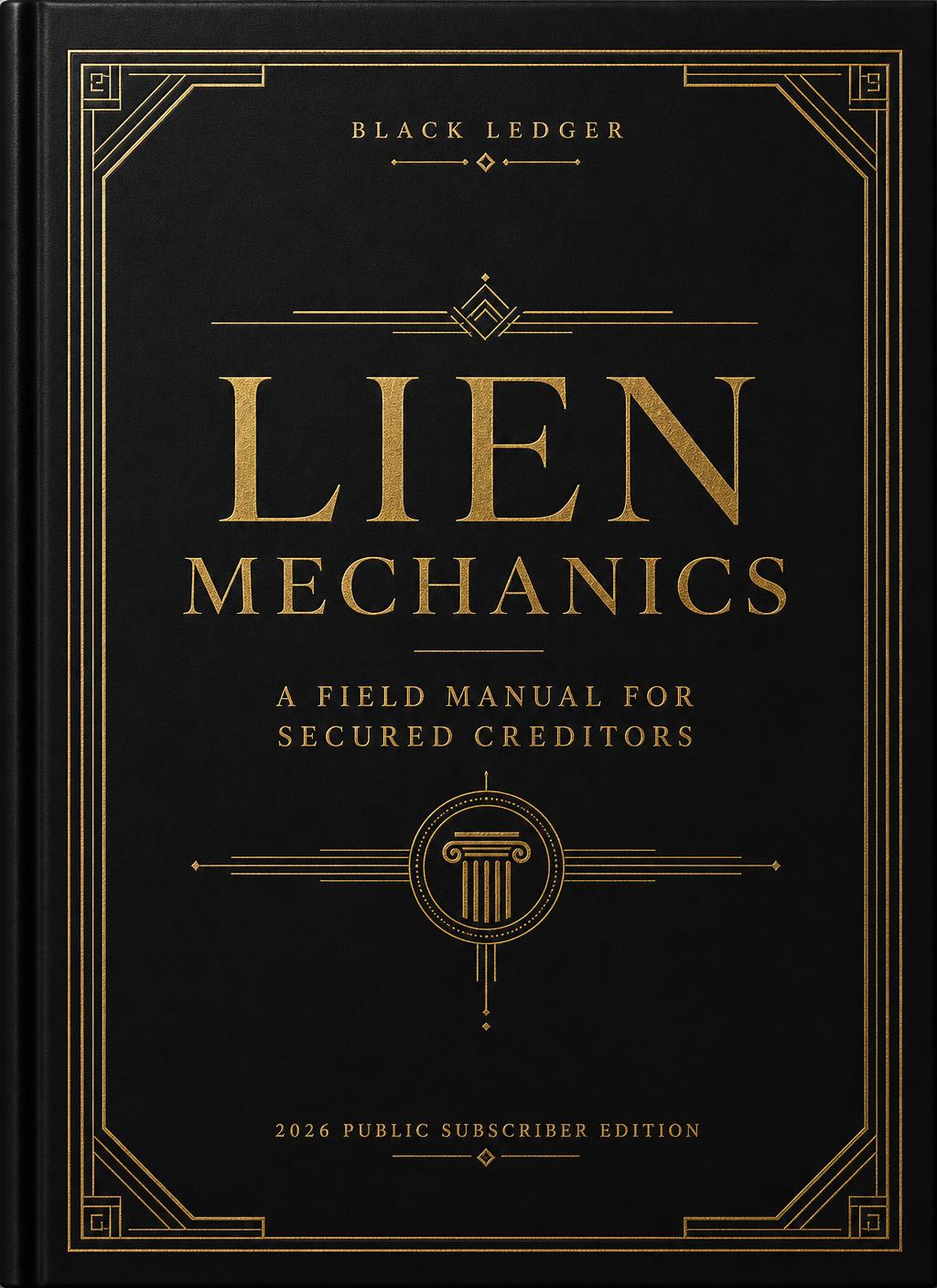
Lien Mechanics
A field manual for secured creditors — attachment, perfection, priority, enforcement, and recovery across UCC Article 9, statutory liens, construction liens, judgment liens, and bond claims.
By Chris Eaton — Author
Published by Black Ledger
2026 Public Subscriber Edition — Published August 2026
Executive Summary
A lien is not merely a document. It is a legal position created by a chain of acts: identifying the debtor, defining the obligation, describing collateral, obtaining enforceable rights, choosing the correct perfection method, preserving continuity, monitoring competing claims, and enforcing in a commercially reasonable manner. The weakest link in that chain usually determines recovery.
Lien Mechanics is organized around the full lifecycle of a secured claim: underwrite, attach, perfect, prioritize, maintain, enforce, and close. Each stage is paired with the question it answers and the failure risk it carries — taking security in property the debtor does not own, filing in the wrong office or under the wrong name, losing priority to a PMSI or lien creditor, letting a financing statement lapse, or enforcing in a way that violates the stay or the commercial-reasonableness standard.
Eight parts cover lien architecture, drafting and collateral classification, priority and competing claims, default and enforcement, statutory and real-property liens, bankruptcy and distress, operating systems and audit tools, and fifty-state research profiles with checklists, glossary, and sources.
- —Separate attachment, perfection, and priority — three distinct legal tests, not one filing
- —Choose the right perfection method: filing, possession, control, or automatic
- —Get debtor name, collateral description, and filing office right the first time
- —See who can prime you — PMSI, buyer, lien creditor, tax lien, statutory lien, or trustee
- —Calendar continuation, lapse, notice, cure, and disposition deadlines independently
- —Enforce without breaching the peace, the stay, or the commercial-reasonableness standard
What You'll Learn
What's inside the manual.
UCC Article 9 Architecture
How security interests are created and where Article 9 ends and other lien regimes begin, across Parts I and II of the manual.
Attachment
Value, debtor rights in the collateral, and an authenticated security agreement — the three facts that make an interest enforceable against the debtor.
Perfection
Filing, possession, control, and automatic perfection: which method the collateral type requires, and what happens when the wrong one is used.
Financing Statements
Debtor identity, collateral descriptions, correct filing office, amendments, continuations, and the lapse events that quietly destroy priority.
Priority & Competing Claims
First-to-file-or-perfect, PMSI superpriority, buyers in ordinary course, lien creditors, and federal and state tax liens.
Construction & Mechanic's Liens
Preliminary notices, deadlines, lien claim content, real-property recording practice, and the notice traps that void otherwise valid claims.
Judgment Liens
How judgment liens attach to real and personal property, how they interact with recorded security interests, and how they are continued.
Bond Claims
Payment and performance bond claims as an alternative or parallel recovery path when lien rights are limited or waived.
Default & Enforcement Strategy
Repossession, breach of peace, notice of disposition, commercially reasonable sale, surplus and deficiency, and strict foreclosure.
Bankruptcy Considerations
The automatic stay, preference and avoidance exposure, adequate protection, and how a perfected position is tested in distress.
Operations, Audits & Templates
Portfolio-level control checklists, lien audits, search protocols, and calendaring systems built for teams rather than one-off filings.
50-State Research Profiles
Alabama through Wyoming research checklists for filing offices, statutory liens, and local procedure — starting points for verification, not filing instructions.
Why This Guide Matters
Most lost recoveries are not lost at enforcement. They are lost earlier — at an unauthenticated agreement, a misspelled debtor name, a filing in the wrong office, or a continuation nobody calendared.
Lien law is unusually sensitive to collateral type, debtor identity, governing law, filing location, notice, timing, and local procedure. A single factual difference can change the outcome.
Priority is the whole game. An unsecured claim and a subordinated claim recover the same way in a distressed estate: last, if at all.
The goal is not to file more liens. The goal is to create enforceable priority, preserve leverage, and convert collateral value into lawful recovery.
Who Should Read It
- —Credit Managers and Credit Analysts
- —Commercial collection professionals
- —CFOs and Controllers
- —Commercial finance and treasury teams
- —Attorneys and litigation support teams
- —Asset-based lenders and secured creditors
- —Construction, staffing, equipment, and distribution credit departments
- —Business owners extending commercial credit
Publication Information
- Title
- Lien Mechanics
- Publisher
- Black Ledger
- Edition
- 2026 Public Subscriber Edition
- Published
- August 2026
- Pages
- 213
This publication is an educational field manual and calendaring aid. It is not legal advice, does not create an attorney-client relationship, and is not a substitute for current statutes, court rules, filing-office instructions, title work, or advice from licensed counsel in the governing jurisdiction. Verify the current enacted version of Article 9 and every applicable state, federal, county, municipal, and contractual rule before relying on any procedure.
Related Resources
Field Manual — Public Subscriber Edition
2026 50-State Judgment & Lien Renewal Guide
Judgment and judgment-lien expiration, renewal mechanics, per-county lien continuation, planning costs, and statutory checkpoints for all 50 states plus federal.
Commercial Credit & Collections — Book 4
The Commercial Lien Playbook
Mastering recovery in high-stakes B2B collections — the strategy, psychology, and legal mechanics of filing and enforcing UCC, mechanic's, and judgment liens, with scripts, templates, and a full lien lifecycle checklist.
From Paper to Capital
Judgment Recovery
A comprehensive field manual covering judgment enforcement, domestication, asset investigation, execution, garnishment, turnover orders, receiverships, fraudulent transfers, bankruptcy considerations, judgment renewal, and nationwide recovery strategy for commercial creditors.